Victoria Navarrete

Toronto, Ontario

I study statistics, economics, and math at the University of Toronto (Trinity College), where I also conduct stats research. I'm currently interning in finance & investments at a pension plan. Reach out! I'm always happy to meet new people, exchange ideas, or go for a run.

Currently

Victoria Navarrete

CV

A snapshot of where I've studied, worked, and what I know.

Education

University of Toronto crest
University of Toronto (Trinity College)
Statistics Specialist, Economics Major, Math Minor
Relevant coursework: Econometrics, Statistics, Linear Algebra, Data Visualisation, Calculus, Mathematical Microeconomics
Present

Experience

TTC Pension Plan logo
Toronto Transit Corporation Pension Plan
Finance Intern
  • Conducted investment research and analysis across teams, supporting portfolio strategies for a $9B+ defined-benefit pension plan.
May 2026 – Aug 2026
UofT Statistical Sciences logo
Department of Statistical Sciences, University of Toronto
Research Assistant – Statistics Education Research
  • Investigated gaps in undergraduate statistical literacy across Canada's U15 universities, assessing how training contributes to the misuse of quantitative methods in research.
  • Synthesised 35 peer-reviewed studies, producing evidence-based recommendations on curriculum improvements using quantitative data analysis (R, Excel) and qualitative literature review.
May 2026 – Aug 2026

Skills

Languages
Python · R · SQL · MATLAB
Quantitative
Econometrics · Bayesian stats · Time series · ML
Tools
Bloomberg · Stata · LaTeX · Git
Languages (spoken)
English (Fluent) · Spanish (Fluent) · French
Download full resume (PDF) ↗

Projects

Selected data analysis and visualisation work.

Born Equal, Made Unequal: The Multi-Stage Collapse of Gender Equality
Data visualisation

Built five interactive visualisations linking gender advantage and GDP per capita across 198 countries. Analysed inequality across survival, education, labour force participation, and maternity policy using UNICEF and OECD data, alongside a written article.

R UNICEF OECD
Interactive World Map on Global Gender Inequality
Interactive map

Cleaned and merged global datasets in R covering 198 countries, then built an interactive world map for cross-country comparison by region, income, and life stage.

R Data visualisation Global data
Coming soon...
In progress

Research

Research work in statistics education and statistical literacy.

← Back to Research
STA496H1Y · Readings in Statistics Summer 2026 Statistical literacy

Tracing through the learning process: a reflective artifact-led timeline

This ePortfolio uses an artifact-led timeline to trace how my understanding of statistical literacy, and of the research process itself, became more precise over the term. I began by wondering how statistics could be made more accessible to life science students through more effective learning processes. Through a process of literature searching, brainstorming, reflection, and synthesis, that interest narrowed to a more impact-driven question relevant to modern circumstances: to what extent does genAI foster personalised learning support versus cognitive laziness for life science statistics learners, and what outcome predominates?

Main themes of ePortfolio
01
Refinement via new evidence and exploration
02
Shifting focus
Better delivery of statistics learning (initial focus)
Better statistical learning itself (final focus)

My research question narrowed as my definition of successful statistics education deepened: from improving the delivery of statistical content, to protecting the independent reasoning that makes statistical literacy meaningful.

Statistical literacyStatistical literacy was a key course concept throughout this learning process, which framed a lot of my ideas throughout this learning process, from the initial purpose in the STA496 Reflection 1 artifact, to the final annotated bibliography’s specific research focus on the tension between genAI’s potential for improving statistical learning outcomes and the risk of introducing cognitive laziness. In STA496, I defined statistical literacy as the ability to engage effectively with statistical concepts and methods that might be needed for future actions. In the context of life science, these future actions could be research, publications, or upper year courses.
Generative AI (genAI)GenAI is a key term used in this course, specifically within my learning process. “GenAI”, short for generative artificial intelligence, can be defined as artificial intelligence that takes in human prompts and outputs new content (such as text or numerical solutions). Within my research scope, genAI was investigated as a potential personalised learning aid for undergraduate life science students.
Cognitive lazinessWithin my learning process, the term “cognitive laziness” results from the idea that genAI can enable students to offload metacognitive effort, hindering deep learning and contributing to what researchers have coined “cognitive laziness” (Yunus et al., 2025).
How reflection on the learning process is shown in this ePortfolio: I’ll raise an important distinction between two different reflective pieces in this ePortfolio: the PDFS titled STA496 Reflection 1, 2, and 3 are course artifacts created at specific points in the term. By contrast, the dark blue boxes titled Reflective Entry 1, 2, and 3 are the ePortfolio’s own reflective entries, all written at the end of the term. These reflective entries look back at the learning experience to analyse how my knowledge, assumptions, uncertainty, research skills, and future academic goals developed over the process.
01
Collect
Start broad enough to see the landscape.

I began with a purpose, not yet a question

This first phase is all about breadth, which is what I started with. Connecting to the ePortfolio’s main theme of refinement via new evidence and exploration, at this point in the process learning occurred via exploring various pieces of evidence: peer-reviewed articles, my own ideas (even if they seemed disconnected and arbitrary), and past experiences. These artifacts showcase the initial starting points from which my first research focus later emerged.

Opening reflection · May 2026Artifact 01

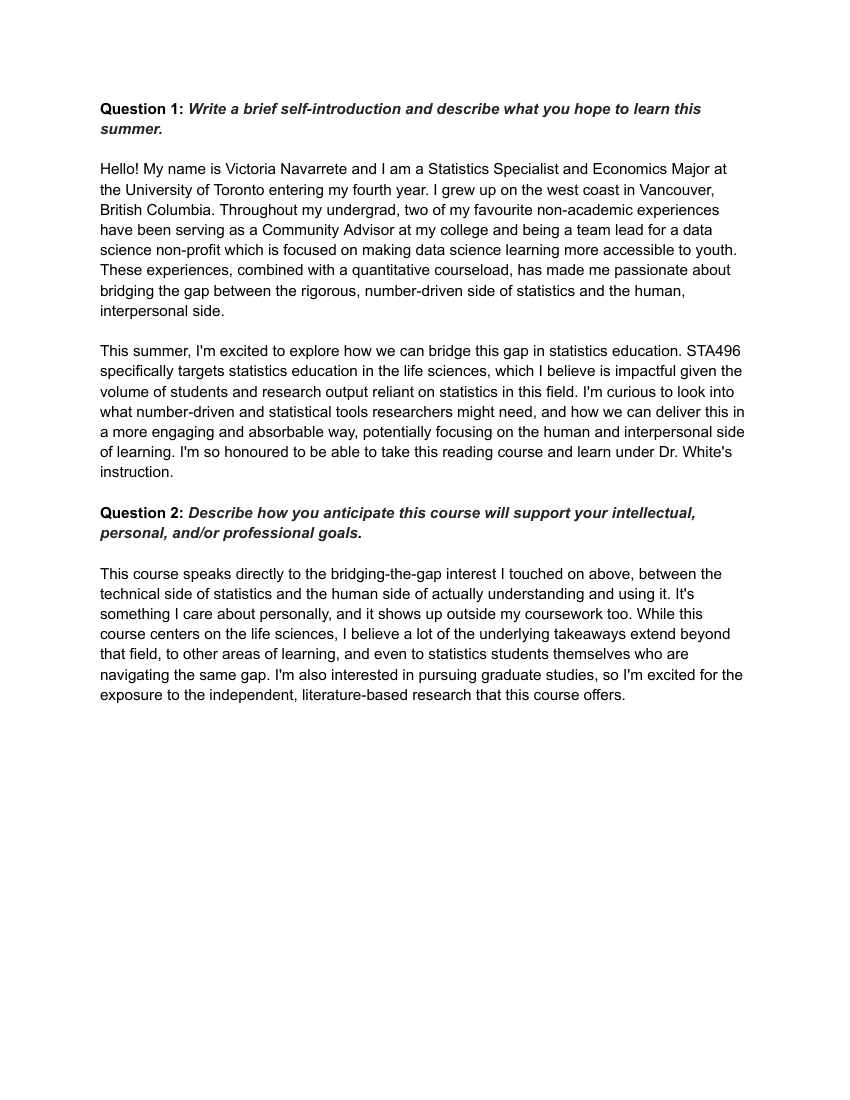
Course artifact: Reflection #1, the baseline

I entered STA496 with a strong personal value of “bridging the gap between the rigorous, number-driven side of statistics and the human, interpersonal side” of learning it. I was excited to blend course concepts and this personal value to explore how this gap could be closed in statistics, specifically for life science students given STA496’s conceptual focus in the life sciences. I had an optimistic belief that delivering statistics in a more engaging manner, potentially targeting the human side of learning, could improve learning outcomes for students.

Preview of STA496 Reflection 1
PDF · personal reflection
STA496 Reflection 1

This simple one-page, three paragraph reflection enshrines my original values (making statistical learning more accessible to youth, blending the quantitative and human side of statistics), and beliefs (that making the learning process more engaging could boost statistical takeaways for students), before later literature searches revised certain beliefs and complicated the picture.

Why it matters: reflection 1 establishes the “before” state needed to demonstrate a true learning timeline. By clearly showcasing this “before” state and reflecting on what values, beliefs, and assumptions I started with as a learner, later stages in the ePortfolio can show how my understanding of what effective statistical learning revises with updated evidence. Additionally, this showcases how the final annotated bibliography, one of the last ePortfolio stages, is simply a refinement of this “before” state.
Assumption I carried in: better engagement and human-focused pedagogy would improve learner absorption of statistical concepts. This is an idea I maintained as valuable throughout the term’s learning experience, although later literature search evidence compelled me to more clearly define what true “learner absorption” is: contrary to my initial thoughts, high performance in external learning metrics (such as essays or tests) and high conceptual understand of statistics are not interchangeable terms.
Early brainstorming · May 2026Artifact 02

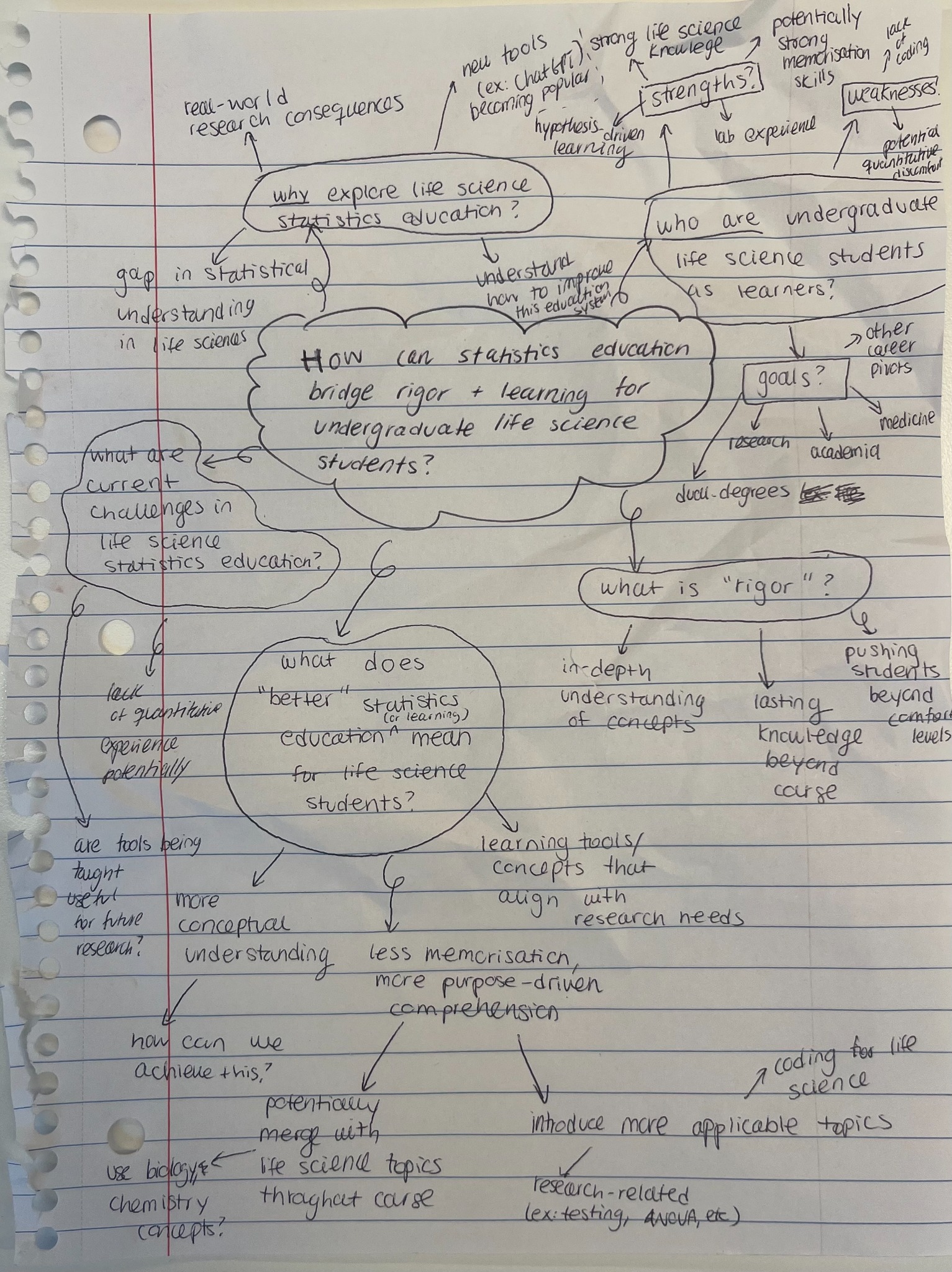
Mind-map brainstorming, what were my own ideas (even if seemingly disconnected and arbitrary)?

Before beginning the process of narrowing and refining, I mapped the course topic against my own interests and motivations, using the values I had touched on during the Reflection 1 artifact to help me develop new ideas about what I would be interested in exploring. In terms of learning, the goal here was not yet to produce a polished research question; it was to more clearly understand where undergraduate life-science statistics education overlapped with my values, and which strands of overlap could potentially turn into a research focus.

Original handwritten mind map · May 2026
Original handwritten mind map exploring how statistics education can bridge rigor and learning for undergraduate life science students
Why it matters: this brainstorming artifact captures initial ideas I had about the course topic, based on previous knowledge (from personal experiences, courses I’ve taken during my undergrad, and extracurricular involvements) and creative, uninhibited “popcorn-style” thinking. Interestingly, many thoughts present on the initial mind-map such as “ChatGPT becoming popular”, “more conceptual understanding [in statistics]”, and “real-world research consequences”, laid the foundation for both final research focus and the broader significance of the final research focus present in the later stage annotated bibliography artifact.
May 24 onwardArtifact 03

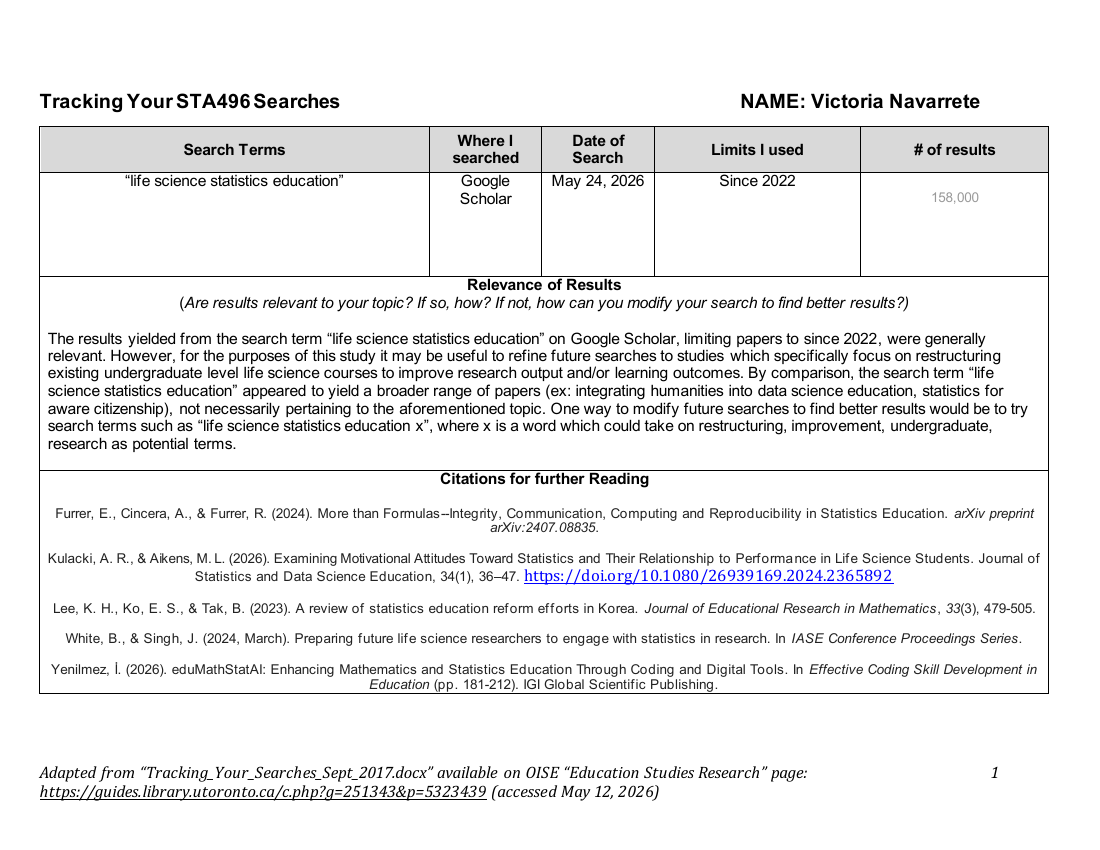
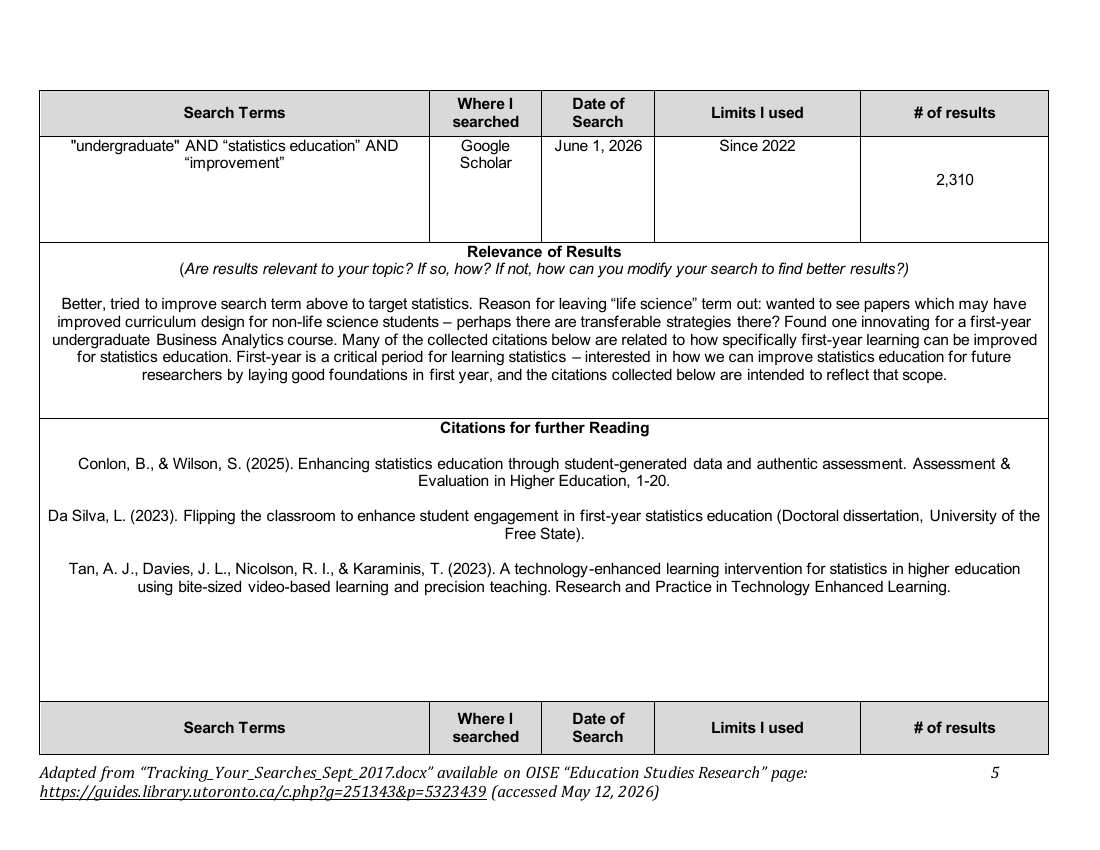
Literature search log, learning to treat searching as data

This STA496 literature search tracking log was relevant to my learning experience as more than just a list of academic papers. Comparing “number of results” and “search terms” columns against “relevance of results” for each distinct literature search, primarily conducted on Google Scholar, helped me learn what an effective literature search comprises (specific research terms, date-filtering, and an interactive trial-and-error approach). Reflecting on my process using the log, earlier searches ranged from 158,000 results for “life science statistics education” to 17,200 results for “undergraduate statistics education restructure”, with one early-stage literature search trial being bluntly recorded as “not great, too broad”. By refining later searches by combining key course-concept related search terms such as “ChatGPT”, “statistics education” and “using”, I was able to obtain a lower result count with each source being more relevant to my potential research interests.

Preview of the STA496 literature-search tracking document
PDF · research-process artifact
Tracking Your STA496 Searches

This artifact is a 13-page log recording search terms, searching platform, date of search, any filters used, and number of searches yielded, as well as a written description of the relevance of the search and potential citations to further explore. This log serves an iterative purpose: each next search can be improved based on reflections made during the prior search.

Why it matters: this artifact demonstrates how my research skills (specifically literature search research skills) developed over the term. When I began using the literature search tracking log, I viewed each entry as a one-time retrieval task. By the end of STA496, I viewed the log as an iterative process, where each result’s relevance directly influenced how the next search term would be conducted by narrowing the search scope and recording specific words that yielded higher quality results. For future research, I am now better equipped in my literature search skills and understand literature search to be a continuous, reflective process instead of many separate searches.
Reflective Entry 1 · Personal learning progress
Accessibility was one of my key initial personal values, and did not (yet) stand on its own as a research focus

At the beginning of this learning process, I made the assumption that if course material was more engaging and interpersonal, improved conceptual learning would automatically ensue; I assumed the most essential piece of the “human side” of statistics education I valued was creating an enjoyable learning experience for students. This assumption also reflected another value of mine, which is that rigorous quantitative statistical topics (present in course material) should be accessible to students. One way I initially theorized this could happen was through making these rigorous topics more “human” and engaging. Something that transformed was my willingness to view engagement itself as proof of conceptual learning. Artifact 3, the literature search, shifted my perspective via introducing a key new piece of knowledge: that engagement, external task performance, and conceptual learning are distinct, despite potential overlaps. Because of this, my focus evolved from how to make statistics more engaging to improve conceptual understanding, to what tools or methods could improve conceptual understanding.

02
Select
Use patterns to decide what deserves focus.

Moving from a broad landscape to an evidence-backed problem

The second phase in my learning process was the selection phrase. This phase revolved around tightening the scope of the problem by selecting and applying relevant evidence, rather than personal interests alone (which was a large component of the first learning process phase).

Late May / early JuneArtifact 04

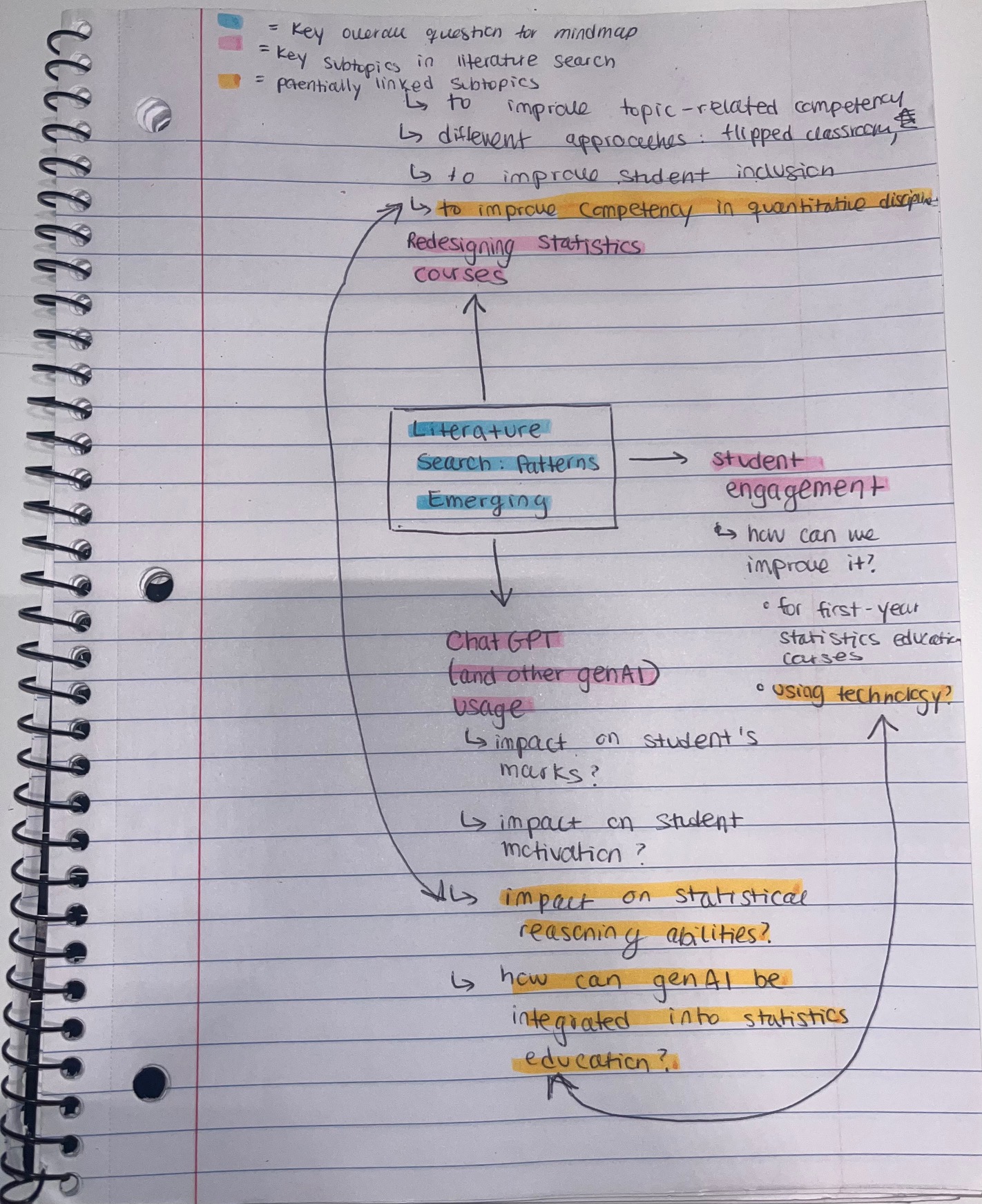
Second mind-map, what patterns were appearing?

As my literature search log expanded, I used another mind-map; this time instead of brainstorming ideas, I used the mind-map to visualised which patterns were occurring across literature pieces, and where connections were present. I noticed course redesign, student engagement, and genAI usage were recurring themes. This encouraged me to question if there was a way to connect all three themes, or pull elements from each to support my course focus of statistics education improvement.

Original handwritten literature-pattern mind map · Late May / early June 2026
Original handwritten literature-pattern mind map showing recurring themes such as course redesign, student engagement, and ChatGPT or other generative AI usage
Why it matters: artifact 4, a second mind-map, shows a crucial part in my learning experience: linking a conceptual connection across isolated sources. This is an early-stage form of synthesis, a skill which was used to a significant extent during the annotated bibliography process.
June 1, 2026Artifact 05

Initial topic of interest, improving first-year statistics education

June 1 literature-search page showing undergraduate statistics education improvement search
Search-log excerpt · June 1
A first substantive narrowing

This page records the decision to investigate first-year statistics education and to borrow potentially transferable strategies from outside life-science contexts.

Why it matters: it shows an evidence-based reason for narrowing and an emerging willingness to cross disciplinary boundaries while still asking whether the transfer was justified.
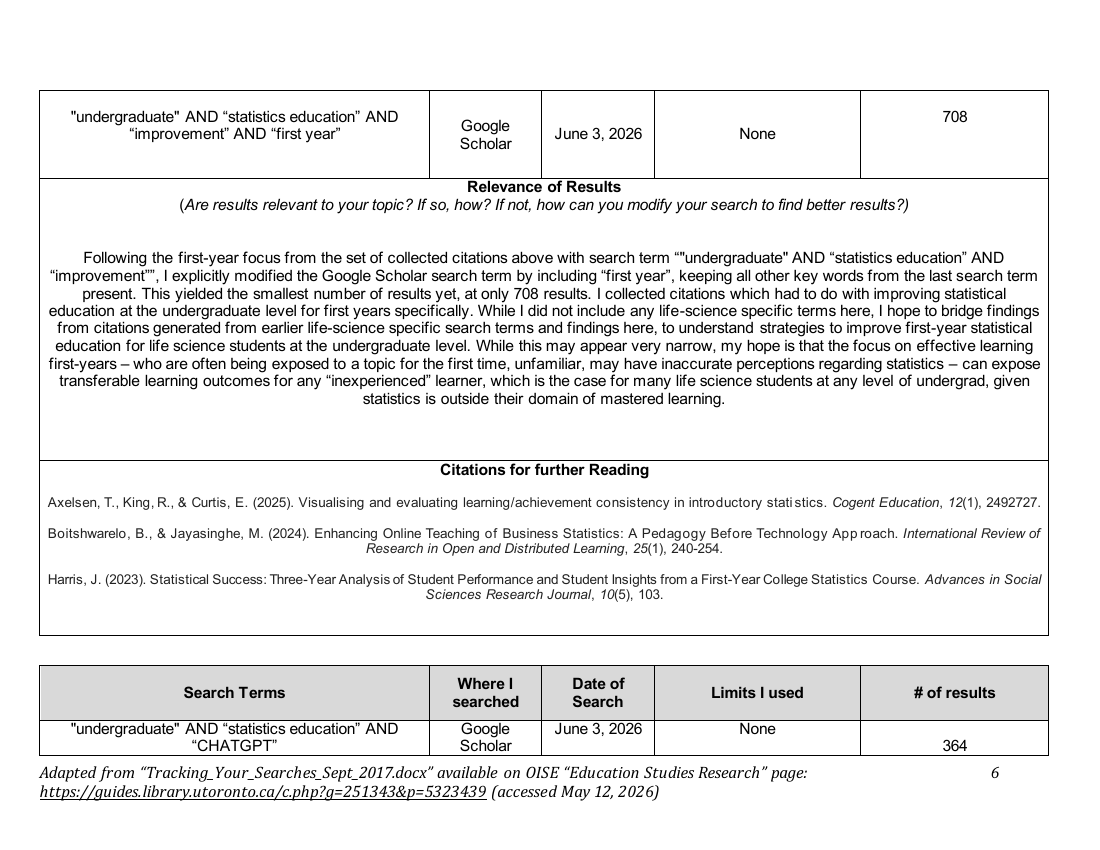
June 3, 2026Artifact 06

Modifying the topic again, bringing GenAI into the problem

June 3 literature-search page showing first-year and ChatGPT search terms
Search-log excerpt · June 3
From “improvement” to a specific educational intervention

The juxtaposition on this page is important: a highly narrowed first-year search sits directly above the first explicit ChatGPT search. The research problem was beginning to move from broad curriculum reform toward how a particular tool changes learning.

Why it matters: this is the pivot point where the project becomes recognisably connected to the eventual annotated bibliography.
What changed in my thinking: I stopped asking only, “What instructional strategies improve statistics education?” and started asking, “What happens to statistical learning when students are already using a powerful new learning tool?”
June 12, 2026Artifact 07

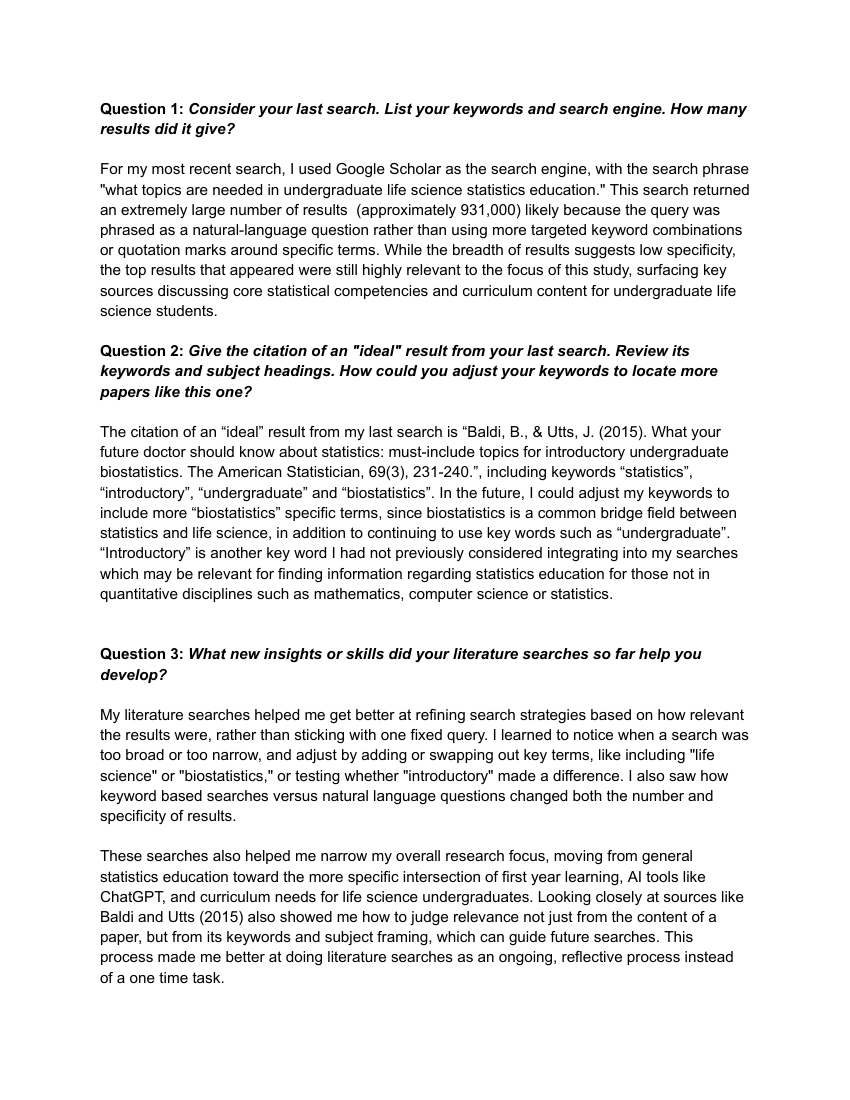
Course artifact: Reflection #2, search became iterative rather than mechanical

By Reflection #2, I could articulate a methodological change in my own behaviour: I was no longer keeping one fixed search query. I was judging relevance, changing terms, comparing natural-language and keyword searches, and allowing the search process to reshape the research focus. I also explicitly identified the emerging intersection of first-year learning, ChatGPT, and life-science curriculum needs.

Preview of STA496 Reflection 2
PDF · reflective artifact
STA496 Reflection 2

The reflection records both a technical research skill, better keyword refinement, and a conceptual shift toward using literature search as an ongoing feedback loop.

Why it matters: it provides direct evidence of learning progression. The change was not simply that I knew more papers; I had changed how I approached finding and evaluating them.
Reflective Entry 2 · Research skill development
Searching became part of the analysis, not a step before it

My literature searching changed from a retrieval task into a research instrument. An early natural-language search returned roughly 931,000 results, while progressively targeted searches produced far fewer and more interpretable results. I learned that search design does not merely locate evidence; it shapes the evidence landscape I can see. I also revised another assumption: narrowing did not always mean adding more constraints. Sometimes sharpening a life-science statistics question required looking beyond life science or statistics education for mechanisms that might transfer across contexts. This is a research skill I want to carry into future literature-based work: document why each search changes, evaluate what its results make visible or leave missing, and let that evidence revise the question rather than forcing the question to stay fixed.

03
Reflect
Make assumptions and gaps visible.

Learning to see refinement as progress

The middle of the course forced me to confront a tendency I had initially treated as a strength: breadth. I liked finding connections and possibilities. Feedback and reflection taught me that a strong research question also requires exclusion, deciding what I am not trying to answer.

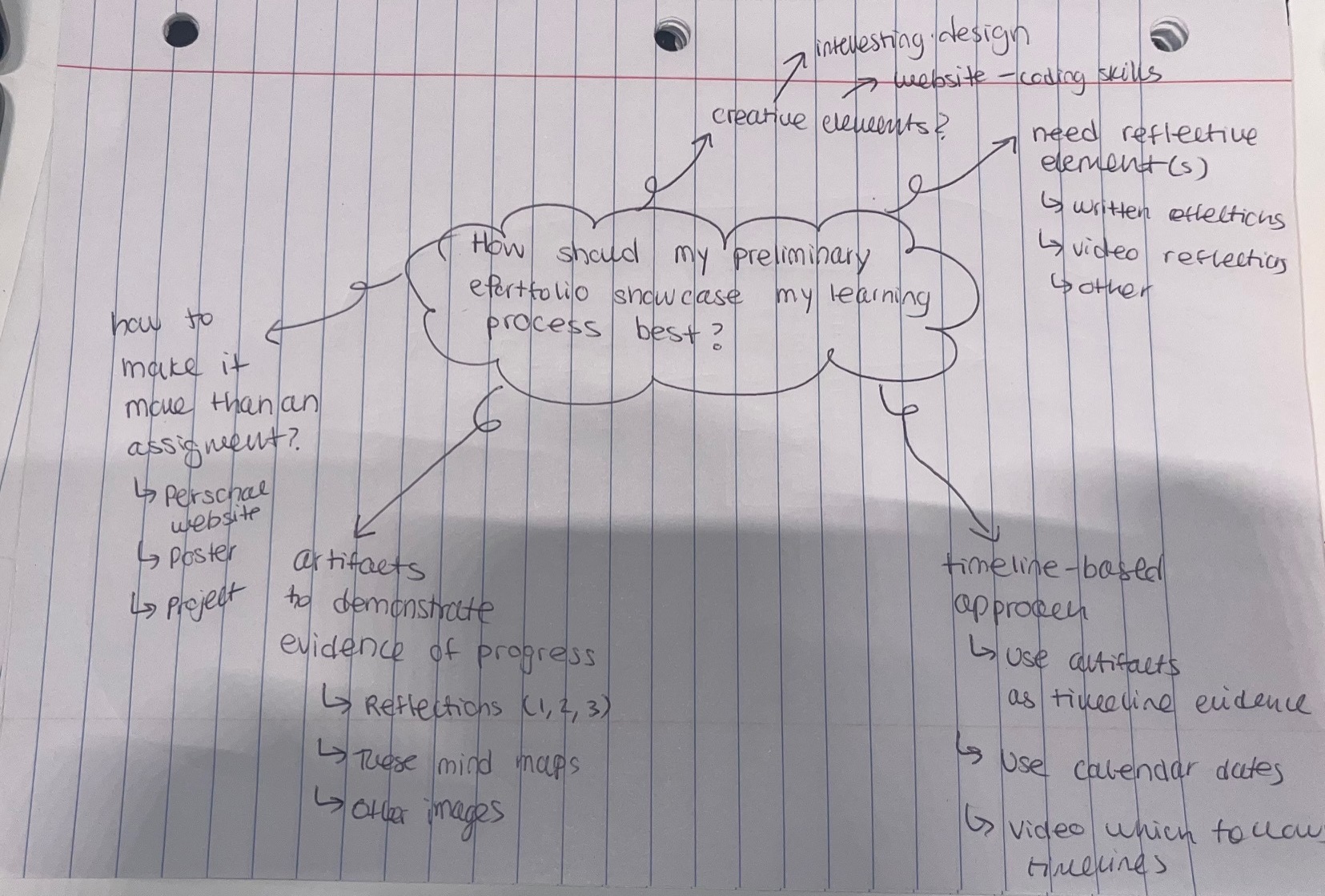
June 2026Artifact 08

Brainstorming the preliminary ePortfolio, making the medium match the goal

I wanted the ePortfolio itself to communicate the bridge I cared about: rigorous statistical research on one side, and the human process of learning on the other. That led to a timeline rather than a static repository, and to including informal notes beside formal documents.

Original handwritten ePortfolio planning mind map · June 2026
Original handwritten mind map exploring how the preliminary ePortfolio should showcase the learning process
Why it matters: this artifact connects design to academic purpose. The visual storytelling is not decoration; it is intended to expose the iterative reasoning that a polished final product would otherwise hide.
June 28, 2026Artifact 09

Preliminary ePortfolio, a clear format, but an unfinished intellectual destination

My preliminary plan already named the four phases used here, collection, selection, reflection, and connection, and committed to a permanent personal website. At the same time, the plan was stronger on how I would show the process than on the precise research question the process would ultimately answer. That gap became useful evidence of where my learning still needed to develop.

Planning document · June 28
Preliminary Plan for ePortfolio

The plan proposes a timeline-oriented narrative, mixed media, handwritten brainstorming notes, and integration into a personal website so that the research sits alongside other parts of my academic and personal identity.

Why it matters: comparing this plan with the final page shows two kinds of refinement at once: the portfolio became more deliberate as a narrative, and the research topic became more precise as an argument.
Gap I can now see: at this point I had a strong idea of the experience I wanted the reader to have, but my research scope still tried to hold too many possibilities at once. A polished format could not compensate for an under-refined question.
After preliminary feedback · July 2026Artifact 10

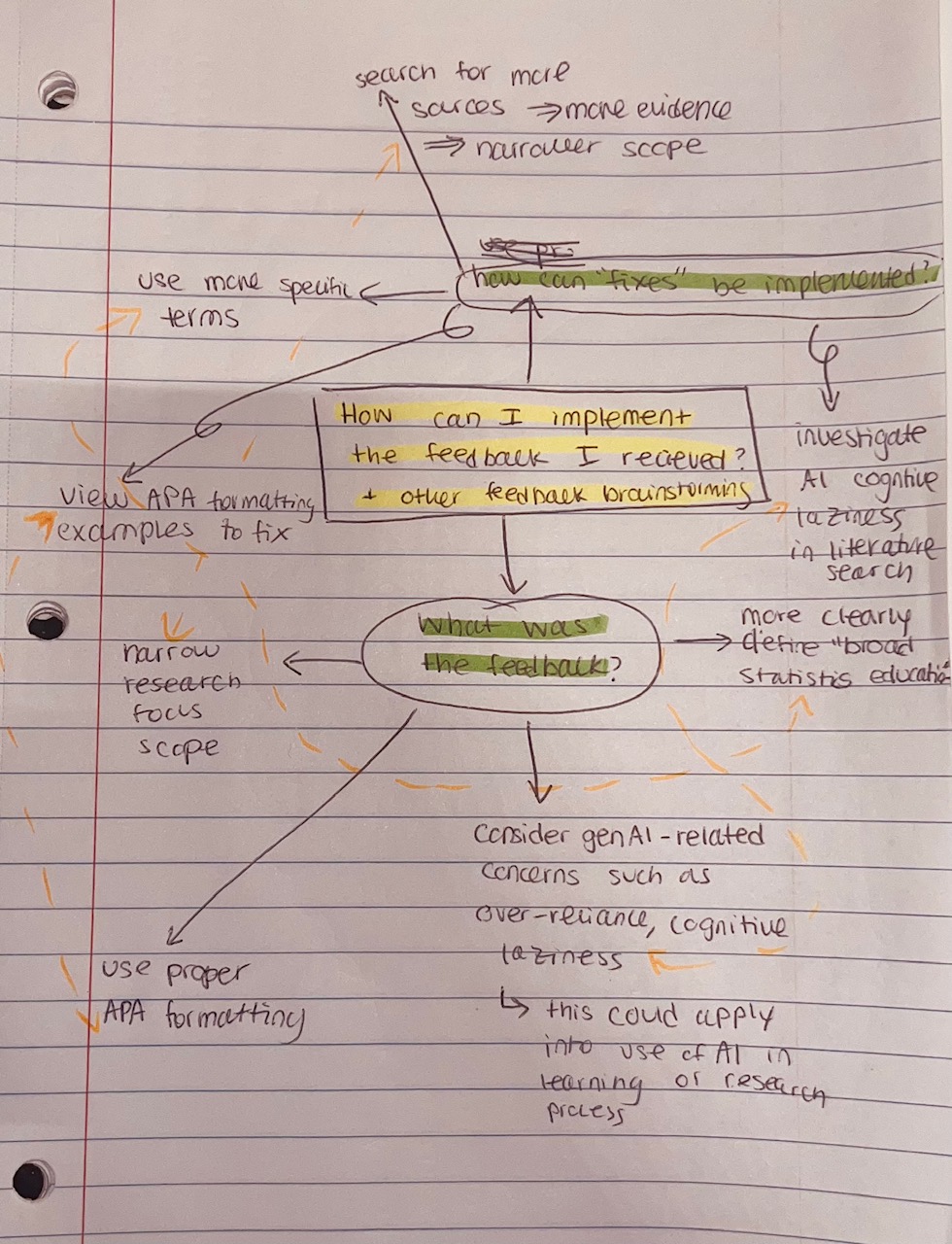
Feedback mind-map, turning critique into a narrower question

Feedback highlighted three especially useful directions: the scope could be narrower; relevant evidence might sit beyond statistics-education journals; and emerging concerns such as over-reliance, responsible GenAI use, and cognitive laziness were worth considering. Rather than treating that feedback as a list of edits, I mapped it against the existing project and used it to choose what the next literature search needed to resolve.

Original handwritten feedback-response mind map · July 2026
Original handwritten feedback-response mind map showing how preliminary feedback was translated into narrower research directions
Why it matters: it shows feedback becoming a research decision. The important change was not “add cognitive laziness” as another topic; it was realizing that cognitive laziness could sharpen the outcome against which the benefits of personalised support were evaluated.
July 21, 2026Artifact 11

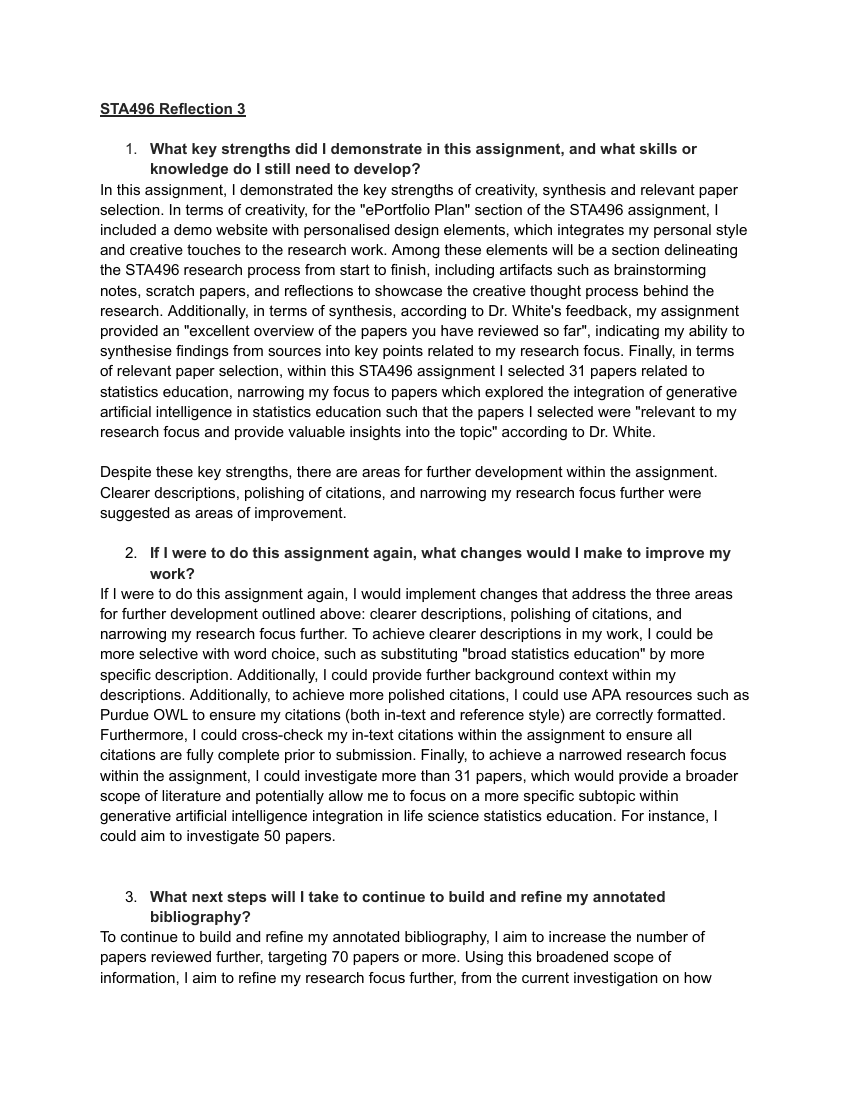
Course artifact: Reflection #3, breadth stopped being automatically synonymous with strength

Reflection #3 is where the self-critique becomes explicit. I identified creativity, synthesis, and relevant paper selection as strengths, but also recorded the need for clearer descriptions, cleaner citations, and a narrower research focus. I specifically named course-specific chatbots and cognitive laziness as possible next directions.

Preview of STA496 Reflection 3
PDF · reflective artifact
STA496 Reflection 3

This reflection documents both confidence and limitation: I could synthesize a large body of relevant papers, but I needed to become more selective about language, scope, and what evidence could genuinely support.

Why it matters: it captures critical self-awareness rather than a success-only narrative. I revised an implicit belief that “more papers and more connections” necessarily meant a stronger project; disciplined narrowing became part of the skill I was learning.
Uncertainty became productive.

At this point I still did not know whether the final literature would support a strongly positive or negative view of GenAI in statistics education. Instead of resolving that uncertainty prematurely, I used it to define what evidence I needed next: measures of conceptual understanding, evidence of over-reliance, and studies that described how GenAI was actually incorporated into learning.

Reflective Entry 3 · Critical self-awareness
I had to revise my belief that breadth was automatically a research strength

Feedback exposed a bias in my own research style: I tended to equate breadth with intellectual seriousness. Finding more papers and preserving more possible branches felt safer than excluding them. Over the term, I revised that belief. A defensible research question requires deciding what will not be answered, so narrowing became analytical discipline rather than a loss of complexity. I also had to sit with uncertainty instead of resolving it too quickly. I did not yet know whether cognitive laziness was sufficiently established, especially in life-science statistics contexts, to support a focused conclusion. Rather than hiding that gap, I used it to decide what evidence to seek next: measures of reasoning, over-reliance, self-regulation, and instructional design.

04
Connect
Turn separate findings into a defensible synthesis.

The question became narrower; the understanding became larger

Connection is where the artifacts stop functioning as separate checkpoints. The final bibliography allowed me to connect the early concern with engaging instruction, the search-process lessons about scope, and the later concern with cognitive laziness into one argument about statistical literacy.

Research context
Why this question mattered

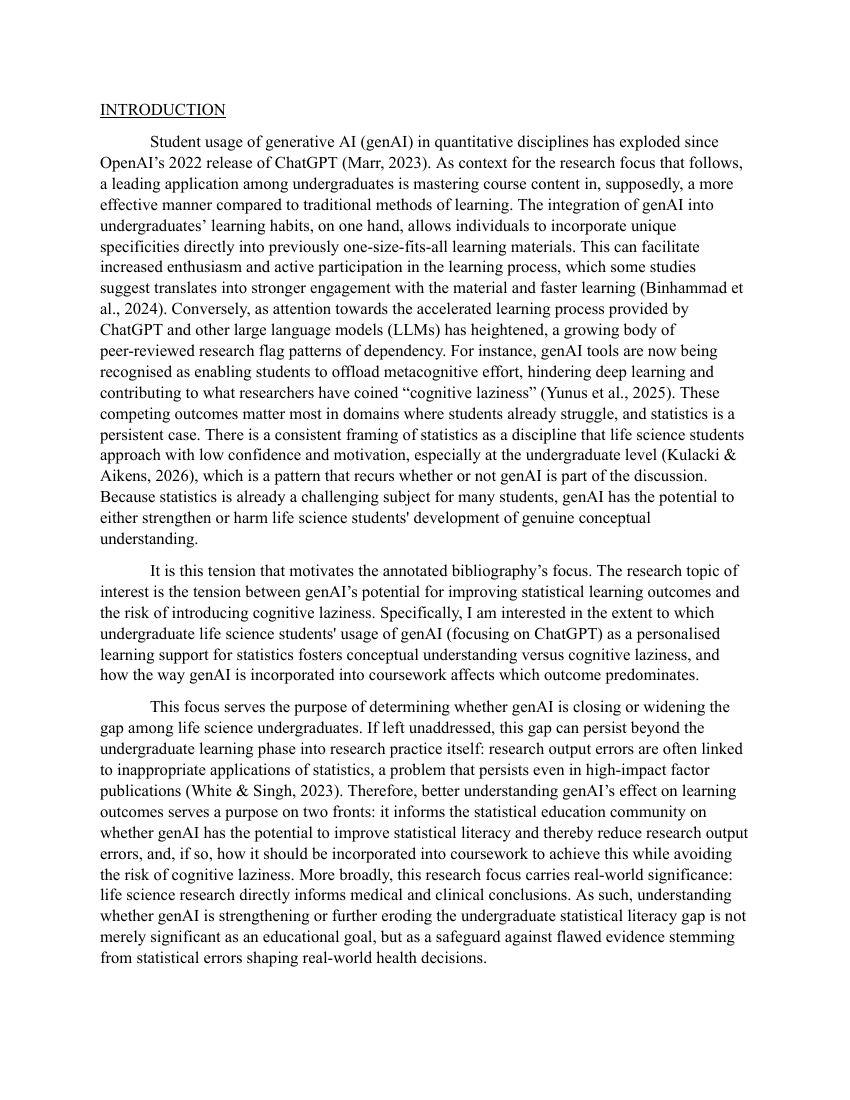
Student usage of generative AI (genAI) in quantitative disciplines has exploded since OpenAI’s 2022 release of ChatGPT (Marr, 2023). This can facilitate increased enthusiasm and active participation in the learning process, which some studies suggest translates into stronger engagement with the material and faster learning (Binhammad et al., 2024). For instance, genAI tools are now being recognised as enabling students to offload metacognitive effort, hindering deep learning and contributing to what researchers have coined “cognitive laziness” (Yunus et al., 2025). There is a consistent framing of statistics as a discipline that life science students approach with low confidence and motivation, especially at the undergraduate level (Kulacki & Aikens, 2026), which is a pattern that recurs whether or not genAI is part of the discussion.

August 2026 · working draftArtifact 12

Working on the annotated bibliography, a useful binary that I eventually had to reject

I refined the topic to the tension between GenAI as a personalised learning support and GenAI as a source of cognitive laziness. For the working bibliography, I deliberately searched both sides: studies of personalised feedback, pacing, and conceptual support, and studies of over-reliance, cognitive offloading, reduced critical thinking, and self-regulation.

Early framingHow can undergraduate statistics education be improved, especially for inexperienced life-science learners?
Working framingIs GenAI helping statistical learning through personalisation, or harming it through cognitive laziness?
Final framingUnder what conditions does GenAI scaffold statistical reasoning, and under what conditions does it substitute for it?
Preview of the annotated bibliography introduction containing the refined research focus
Working research snapshot · August
Personalised support vs. cognitive laziness

The two-lens structure gave the bibliography a tractable way to collect opposing findings. It was analytically useful, but I later recognised that “pro-GenAI” and “anti-GenAI” were too blunt: studies were often measuring different outcomes or different modes of use.

Why it matters: this is where refinement becomes conceptual rather than merely narrower. The final insight came from questioning the categories I had created for the literature.
August 22, 2026Artifact 13

Final annotated bibliography, from “which side is right?” to “what mechanism explains both?”

The final synthesis across twelve core sources did not support a binary conclusion. Studies reporting personalised feedback, guided problem solving, pacing, and repeated examples found stronger engagement, reasoning, or learning gains; studies centred on over-reliance found weaker independent problem-solving, critical thinking, metacognitive effort, and self-regulation. The pattern connecting both groups was how GenAI was used: as scaffolding for a learner's own cognitive process, or as a substitute for it.

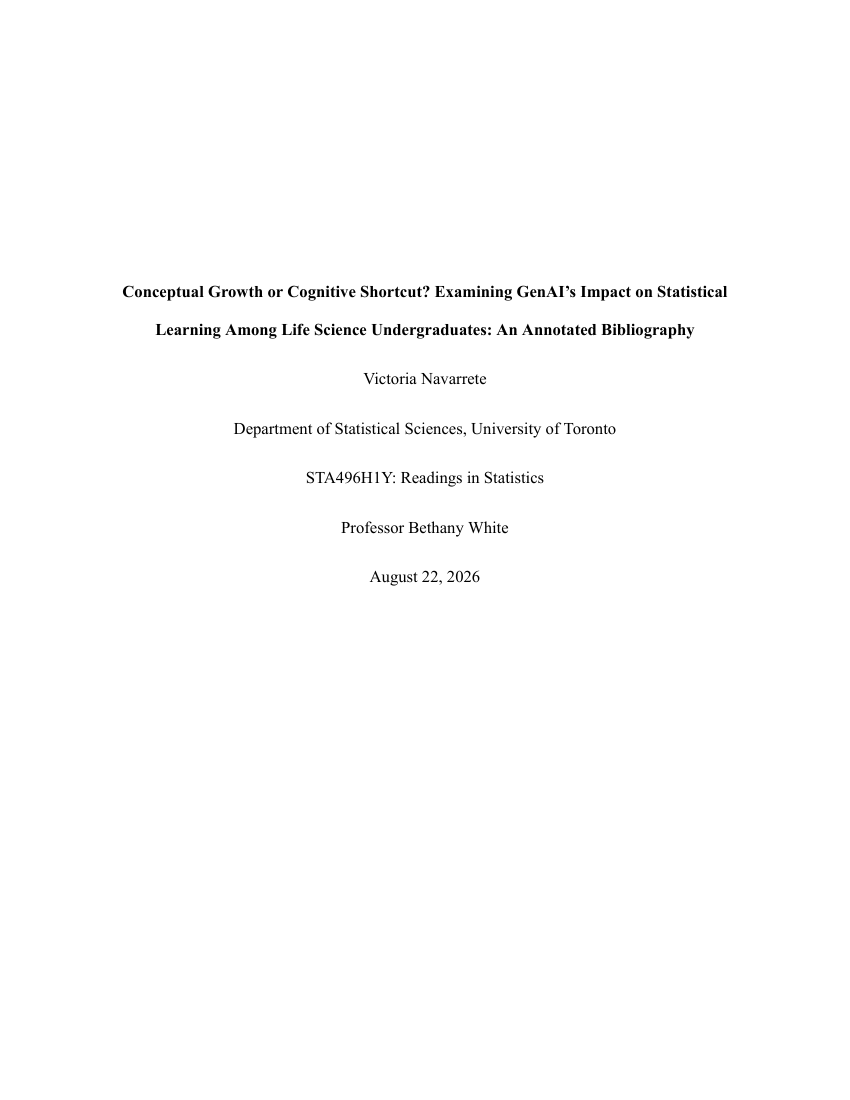
Cover of the final STA496 annotated bibliography
PDF · final research artifact
Conceptual Growth or Cognitive Shortcut?

The 13-page final bibliography evaluates source methodology and relevance, then synthesises evidence across personalised learning, statistical reasoning, cognitive offloading, self-regulation, and instructional design.

Why it matters: this artifact is the endpoint of the timeline and the strongest evidence of growth in statistical-education knowledge, source evaluation, and synthesis. It does not merely collect research; it reconciles apparently conflicting findings by identifying a mechanism that explains when each is plausible.
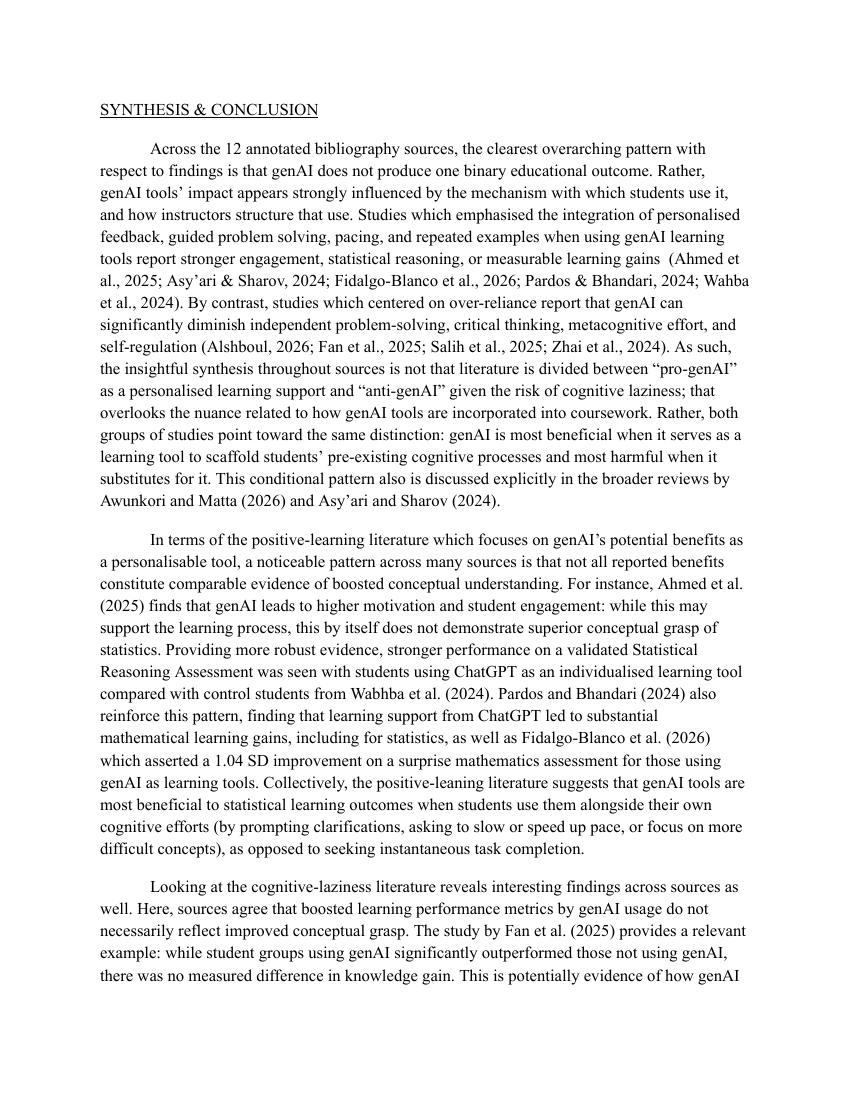
Preview of the synthesis and conclusion page of the final annotated bibliography
Synthesis excerpt · page 10
The distinction that resolved the tension

The synthesis separates learning outcomes that initially looked interchangeable. Motivation, confidence, task performance, statistical reasoning, and knowledge gain are different measures. A student can become faster or higher-scoring without developing an equivalent increase in conceptual understanding.

Why it matters: this distinction changed my own definition of successful statistical education. Statistical literacy cannot be inferred from a polished output alone; the learner's reasoning process matters.
Reflective Entry 4 · Transformation and future academic goals
My final position is less binary, and more demanding of evidence

The final synthesis changed both my substantive understanding of statistical literacy and how I think about educational evidence. I no longer see GenAI as inherently pro-learning or anti-learning. The same tool can support or weaken learning depending on whether it scaffolds or substitutes for cognitive work, and apparent success can change depending on whether a study measures motivation, performance, reasoning, or durable knowledge. That made my original "better delivery" framing feel incomplete: accessibility matters, but statistical literacy also requires independent interpretation and evaluation. I still cannot claim that the literature gives a definitive causal answer for life-science undergraduates specifically; the evidence is young and methodologically varied. For future graduate study and research, I want to carry this lesson forward by asking not only whether an educational intervention improves performance, but what reasoning process it changes and what evidence would justify that conclusion.

BeforeStatistical literacy as content + delivery

I was primarily interested in what students need to know and how statistics could be taught in a more engaging, absorbable way.

NowStatistical literacy as independent judgment

I now see literacy as including the ability to reason through, question, and evaluate statistical information even when a tool can produce an answer instantly.

ImplicationCourse design must protect the reasoning process

The key question is not simply whether GenAI is available, but whether its use requires active cognition, self-regulation, and evaluation rather than bypassing them.

Polished connection · the message I leave with

The same process that improved my research question also changed my understanding of statistical literacy. Refinement was not a reduction of the project; it was the mechanism through which I learned to distinguish visible performance from genuine understanding, and access to statistical answers from the capacity to reason statistically.

What I still do not know

The literature leaves important uncertainty. Direct evidence specific to life-science undergraduates remains more limited than the broader education literature, so transfer across disciplines should be made cautiously. Some studies measure attitudes or task performance rather than durable conceptual understanding, and GenAI systems themselves are changing quickly. These limitations make the conditional conclusion more appropriate than a universal claim: structured, cognitively active use appears promising, but the exact designs that best preserve statistical reasoning still require further study.

References

Ahmed, M., Zaid, N. M., & Abdullah, A. H. B. (2025). The impact of integration of AI in statistics learning on student motivation and learning engagement in higher education sector. International Journal of Academic Research in Progressive Education and Development, 14(1), 426–436.

Alshboul, H. (2026). AI cognitive laziness in programming learning among university students. Journal of Humanities and Social Sciences Studies, 8(4), 26–30.

Asy’ari, M., & Sharov, S. (2024). Transforming education with ChatGPT: Advancing personalized learning, accessibility, and ethical AI integration. International Journal of Essential Competencies in Education, 3(2), 119–157.

Awunkori, E., & Matta, V. (2026). Statistics education rebooted in the age of artificial intelligence. Journal of Decision Systems, 35(1), 2657509.

Binhammad, M. H. Y., Othman, A., Abuljadayel, L., Al Mheiri, H., Alkaabi, M., & Almarri, M. (2024). Investigating how generative AI can create personalized learning materials tailored to individual student needs. Creative Education, 15(7), 1499–1523.

Fan, Y., Tang, L., Le, H., Shen, K., Tan, S., Zhao, Y., Shen, Y., Li, X., & Gašević, D. (2025). Beware of metacognitive laziness: Effects of generative artificial intelligence on learning motivation, processes, and performance. British Journal of Educational Technology, 56(2), 489–530.

Febriyanti, F., Muntoha, T., & Uminar, A. N. (2026). The Ghost Learner Paradox: A systematic review of metacognitive laziness in the age of generative AI. Journal of Socio-Digital Integration, 1(1), 1–13.

Fidalgo-Blanco, A., Fonseca-Escudero, D., & Sein-Echaluce, M. L. (2026). An integrated model based on generative AI for personalized learning and formative feedback. RIED-Revista Iberoamericana de Educación a Distancia, 29(2), 209–233.

Khosravi, H., Shibani, A., Jovanovic, J., Pardos, Z. A., & Yan, L. (2025). Generative AI and learning analytics: Pushing boundaries, preserving principles. Journal of Learning Analytics, 12(1), 1–11.

Kulacki, A. R., & Aikens, M. L. (2026). Examining motivational attitudes toward statistics and their relationship to performance in life science students. Journal of Statistics and Data Science Education, 34(1), 36–47.

Marr, B. (2023, May 19). A short history of ChatGPT: How we got to where we are today. Forbes. https://www.forbes.com/sites/bernardmarr/2023/05/19/a-short-history-of-chatgpt-how-we-got-to-where-we-are-today/

Pardos, Z. A., & Bhandari, S. (2024). ChatGPT-generated help produces learning gains equivalent to human tutor-authored help on mathematics skills. PLOS ONE, 19(5), e0304013.

Salih, S., Husain, O., Hamdan, M., Abdelsalam, S., Elshafie, H., & Motwakel, A. (2025). Transforming education with AI: A systematic review of ChatGPT’s role in learning, academic practices, and institutional adoption. Results in Engineering, 25, 103837.

Wahba, F., Ajlouni, A. O., & Abumosa, M. A. (2024). The impact of ChatGPT-based learning statistics on undergraduates’ statistical reasoning and attitudes toward statistics. Eurasia Journal of Mathematics, Science and Technology Education, 20(7), em2468.

White, B., & Singh, J. (2024). Preparing future life science researchers to engage with statistics in research. IASE 2023 Satellite Conference – Fostering Learning of Statistics and Data Science.

Yunus, A., Gay, P. R., & Lee, O. T. (2025). From co-design to metacognitive laziness: Evaluating generative AI in vocational education [Preprint]. arXiv.

Zhai, C., Wibowo, S., & Li, L. D. (2024). The effects of over-reliance on AI dialogue systems on students’ cognitive abilities: A systematic review. Smart Learning Environments, 11(1), 28.

Complete annotations, DOIs/URLs, and the full bibliography are available in the final annotated bibliography PDF above.

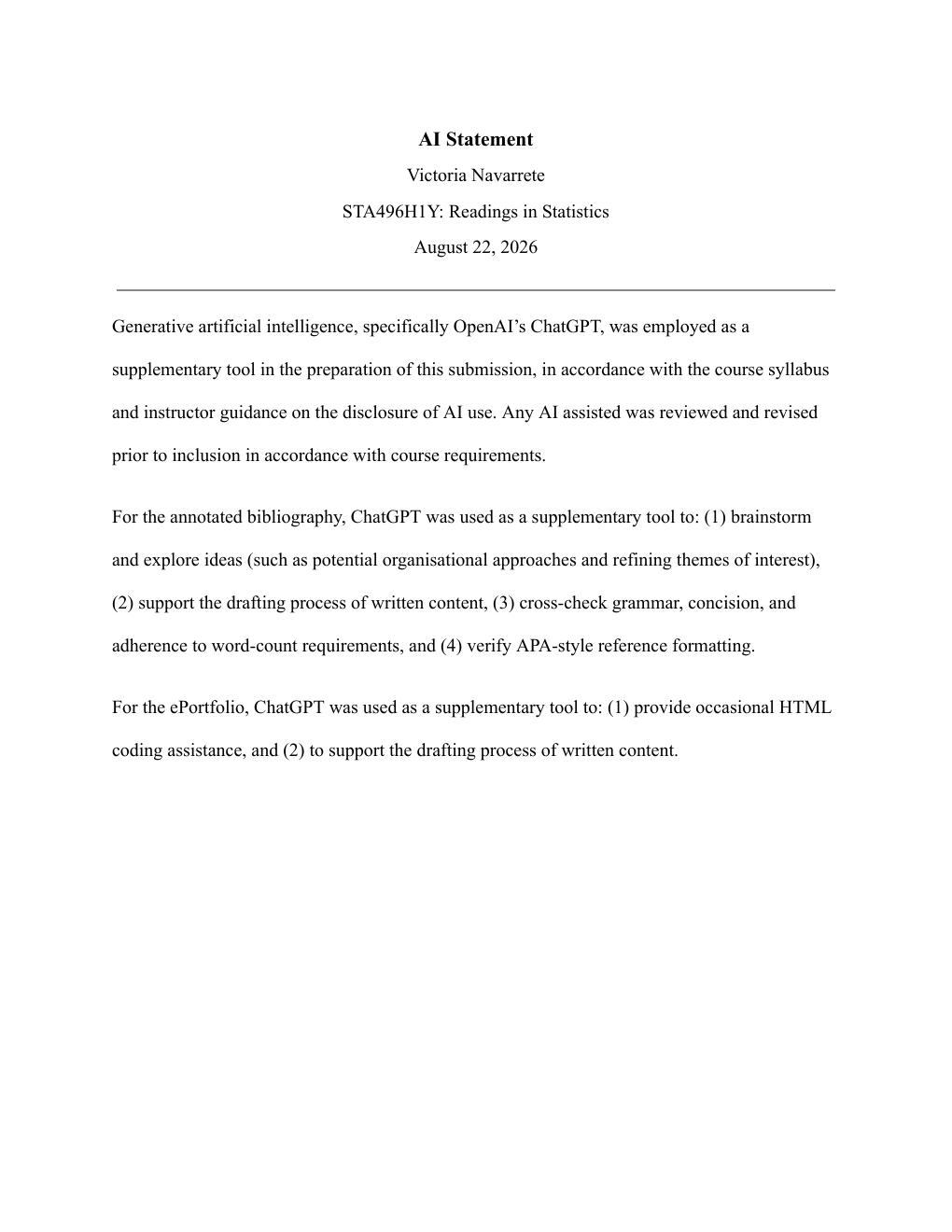
Preview of STA496 GenAI acknowledgement
Epilogue · Artifact 14 · PDF
GenAI Acknowledgement

This statement documents where ChatGPT was used as a supplementary tool in the annotated bibliography and ePortfolio process, including brainstorming, drafting support, editing, APA-format checking, and occasional HTML coding assistance.

Why it matters: the project ultimately asks when GenAI functions as a support for learning rather than a substitute for thinking. Ending with a transparent record of my own use applies that same standard of responsible use to the production of this portfolio.
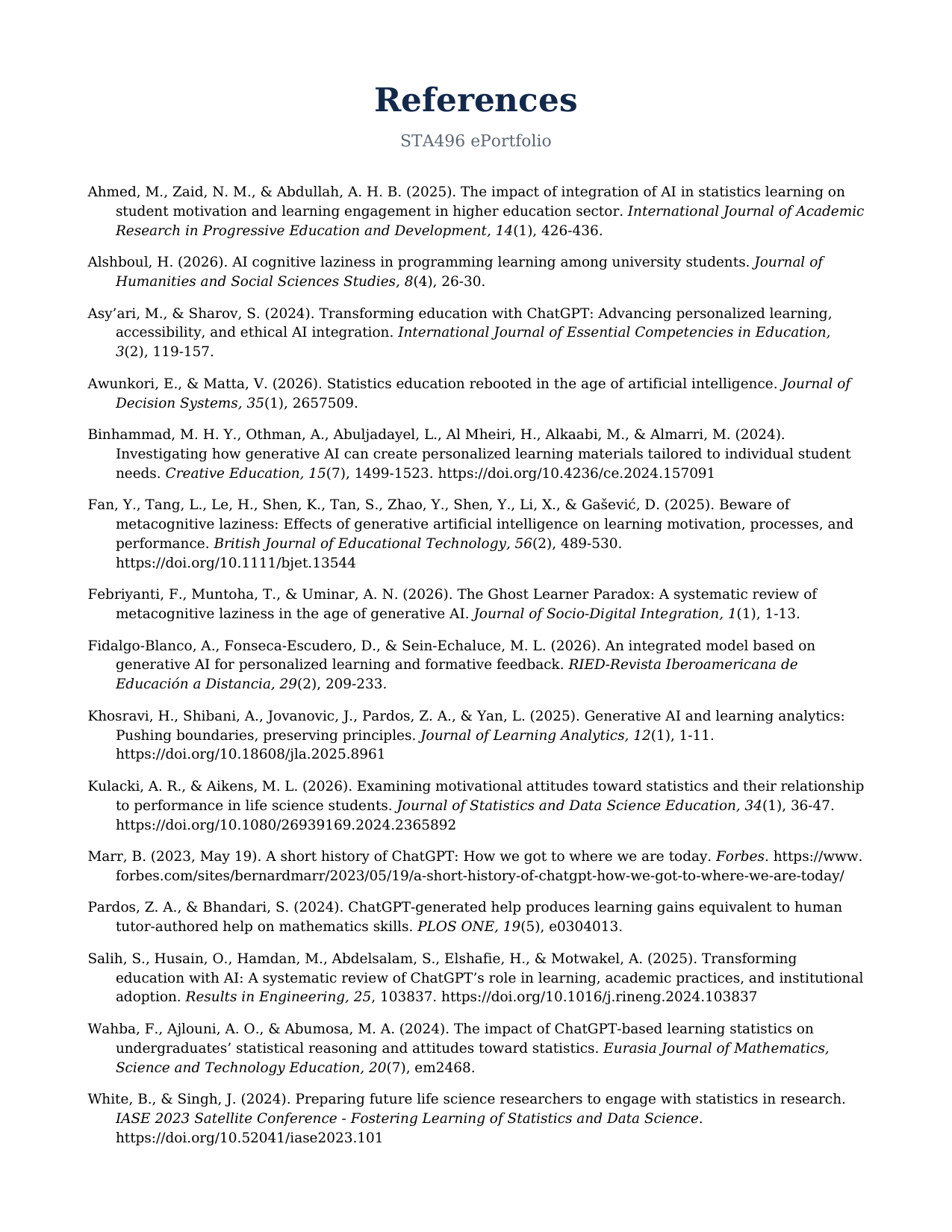
Preview of the ePortfolio APA references
Epilogue · Artifact 15 · PDF
References

APA-style references for the sources cited in the ePortfolio narrative and used throughout the final research synthesis. The complete source annotations remain available in the final annotated bibliography artifact above.

Why it matters: this final artifact makes the evidence base behind the portfolio explicit and keeps the reflective narrative connected to the scholarship that informed it.

Personal

A few things I care about when I'm not at a desk.

[326.6]km
this year
[21:21]
5K PR
[49:40]
10K PR
[1:55]
half marathon PR
Coming soon...
Beach at sunset with palm trees and people near the shoreline
More coming soon...

Contact

Open to research collaborations, internship and full-time opportunities, and interesting conversations.